
Masonry Heaters-Technical Details
Code Considerations & Planning Guides
This information is provided to facilitate an easy process between architects, homeowners, building officials, and masonry heater and oven builders. While these resources provide good background information, they should not be considered a replacement for the important process of finding a masonry heater builder in your area and communicating directly beginning early in the planning process. Masonry heaters interact with many important elements of a building and, therefore, good planning is essential for a successful project. Click here to find one of our Certified Heater Masons.
ASTM E1602 – 03(2010) e1 Standard Guide for Construction of Solid Fuel Burning Masonry Heaters
Available for purchase from ASTM International. From website description: “This guide can be used by code officials, architects, and other interested parties to evaluate the design and construction of masonry heaters. It is not restricted to a specific method of construction, nor does it provide all specific details of construction of a masonry heater. This guide does provide the principles to be followed for the safe construction of masonry heaters. It is not restricted to a specific method of construction, nor does it provide all specific details of construction of a masonry heater. This guide does provide the principles to be followed for the safe construction of masonry heaters.”
From 2024 International Residential Code (IRC):
R1002.2 Installation.
Masonry heaters shall be installed in accordance with this section and comply with one of the following:
Masonry heaters shall comply with the requirements of ASTM E1602.
Masonry heaters shall be listed and labeled in accordance with UL 1482 or CEN 15250 and installed in accordance with the manufacturer’s instructions.
It is important to see that masonry heaters that meet the requirements of ASTM E1602 do not need to be a listed/tested appliance like a wood stove. This is consistent with the EPA policy on masonry heaters as well,
“Masonry heaters currently do not require EPA certification.”
Clearances to combustibles are a secondary matter, taken up in the next section of the IRC:
R1002.5 Masonry heater clearance
Combustible materials shall not be placed within 36 inches (914 mm) of the outside surface of a masonry heater in accordance with NFPA 211 Section 8-7 (clearances for solid-fuel-burning appliances), and the required space between the heater and combustible material shall be fully vented to permit the free flow of air around all heater surfaces.
Exceptions:
Where the masonry heater wall is not less than 8 inches (203 mm) thick of solid masonry and the wall of the heat exchange channels is not less than 5 inches (127 mm) thick of solid masonry, combustible materials shall not be placed within 4 inches (102 mm) of the outside surface of a masonry heater. A clearance of not less than 8 inches (203 mm) shall be provided between the gas-tight capping slab of the heater and a combustible ceiling.
Masonry heaters listed and labeled in accordance with UL 1482 or CEN 15250 shall be installed in accordance with the listing specifications and the manufacturer’s written instructions.
Summary There are two forms of Masonry Heaters within the building code that are acceptable for construction:
Listed (According to UL 1482, or the CEN 15250)
Unlisted (Built According to the ASTM E1602 Code).
Listed Heaters:
Will have the clearances to combustibles specified by the manufacturer as dictated to them from their certification testing.
Unlisted Heaters:
These heaters have two sets of clearances to combustibles.
1. Heaters built within the Code-specified minimum wall thicknesses for the Heater Firebox (8” total), and Flue Gas Channels (5” total). These heaters have a 4” clearance from combustibles on the sides and back.
2. Heaters built without the code-specified minimum wall thicknesses for the Firebox and Flue Gas Channels. These heaters will have less than 8” of total wall thickness from the inside of the firebox to the outside masonry, and/or less than 5” thickness from the inside of the flue channels to the outside masonry. These heaters will have a minimum clearance to combustibles of 36”.
Foundations:
Another Point of consideration for Masonry Heaters is foundations. From ASTM E1602:
“5.1 Foundation—Masonry heater foundations and foundation walls shall meet local building codes for standard masonry fireplaces and shall be designed with consideration given to the mass and size of the masonry heater.”
A common question is whether a masonry heater can be built on a structurally reinforced wood floor. There are two answers:
1. Listed Heaters: As from above, listed heaters are listed according to the UL 1482, or the CEN 15250 code. They can therefore also be listed to have a zero-clearance masonry heater base pad. As a part of the listing process, listed heaters are tested in all areas to find their clearances to combustibles; this is the main purpose of the testing process that listed heaters undergo. These heaters MIGHT be able to be built on top of a structurally supported wood floor. Consult the manufacturer.
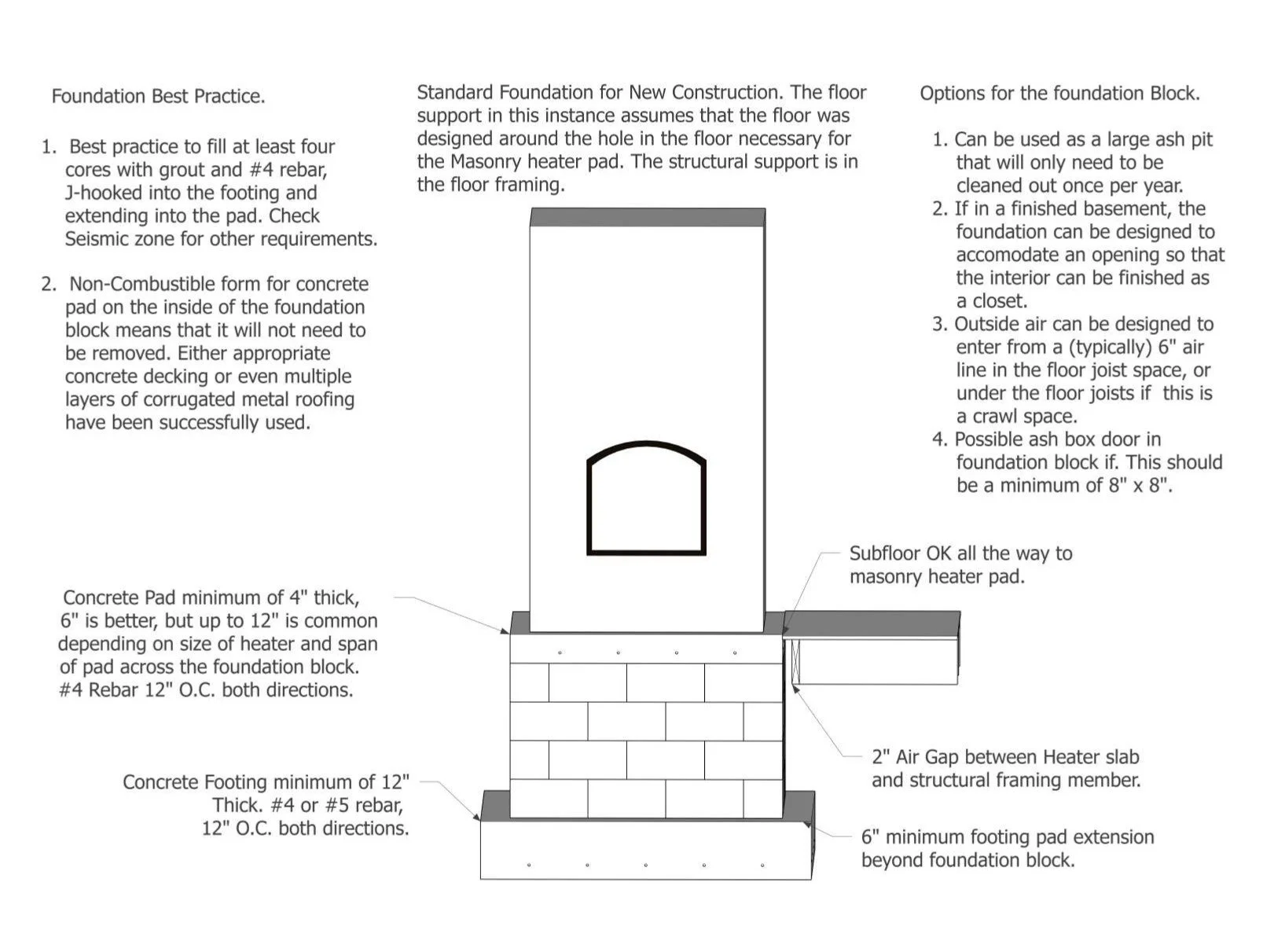
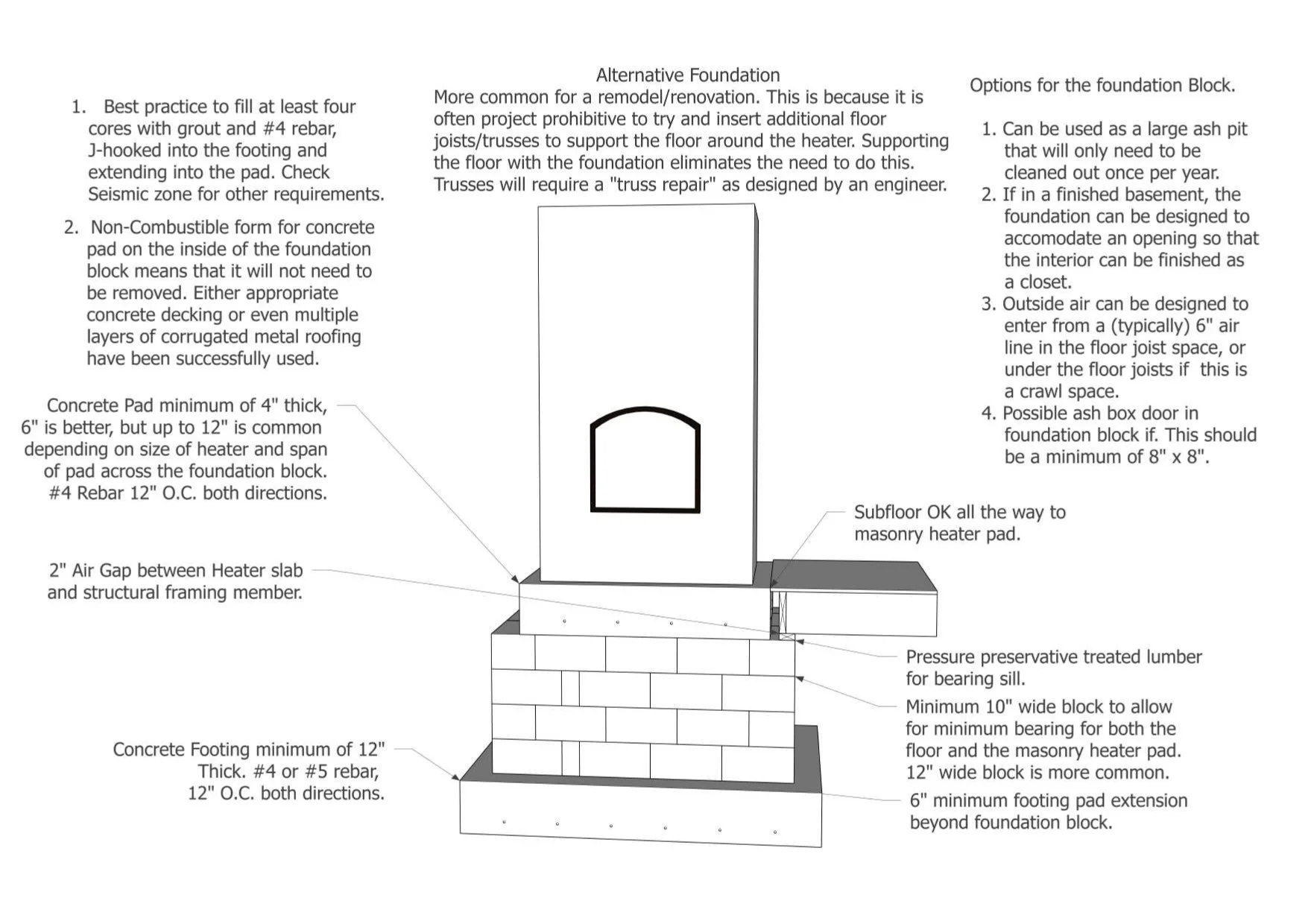
2. Unlisted Heaters, built to the ASTM E1602 Code: As a requirement, these heaters must be built on top of a Non-combustible foundation. From ASTM E 1602, “Masonry heater foundations and foundation walls shall meet local building codes for standard masonry fireplaces.” This is most commonly going to be a concrete foundation. Unless otherwise designed and signed off by an engineer, ASTM E1602-compliant masonry heaters must have a concrete foundation to support them. Please see the foundation examples below.
From the IRC:
A. R1002.3 Footings and foundations.
The firebox floor of a masonry heater shall be a minimum thickness of 4 inches (102 mm) of noncombustible material and be supported on a noncombustible footing and foundation in accordance with Section R1003.2.
B. R1003.2 Footings and foundations.
Footings for masonry chimneys shall be constructed of concrete or solid masonry not less than 12 inches (305 mm) thick and shall extend not less than 6 inches (152 mm) beyond the face of the foundation or support wall on all sides. Footings shall be founded on natural undisturbed earth or engineered fill below frost depth. In areas not subjected to freezing, footings shall be not less than 12 inches (305 mm) below finished grade.
A word about chimneys:
Masonry Heaters DO require a chimney for exhausting the flue gases from combustion. A metal fabricated chimney is common practice for masonry heater construction, but masonry chimneys are still perfectly acceptable. Fabricated chimneys need to be installed according to the manufacturer’s specifications, and masonry chimneys need to be installed according to the IRC regarding masonry chimneys. The flue size will depend on the size of the masonry heater, but typically a smaller heater might have a 6” interior diameter round chimney pipe, and a larger heater will likely have an 8” round interior diameter chimney pipe. Masonry chimneys will likely need an 8’x12” clay flue tile.
Masonry Heaters work best when the chimney remains within the building envelope of the home until it penetrates through the attic/roof and extends to its required height. The reason for this is that draft, simply put, is a pressure that is created by the difference in temperature inside the chimney pipe and the outside air temperature. If the temperature inside the chimney pipe is warmer than the outside air temperature, the system will, under normal circumstances, have a positive draft. This will keep the chimney from backdrafting or leaking flue gases into the home. This is especially important on cold startups, warmer days, or on the shoulder seasons of heating when draft pressure is naturally lower.
In Summary:
All Masonry Heaters will require a chimney and must fall under one of two categories:
Listed to UL 1482, or the CEN 15250 code.
These will have their own specified clearances to combustibles from the Manufacturer and might be able to be built on top of a structurally reinforced wood floor; check with the manufacturer. The common foundation is still masonry.
Unlisted and built according to the ASTM E1602 Code.
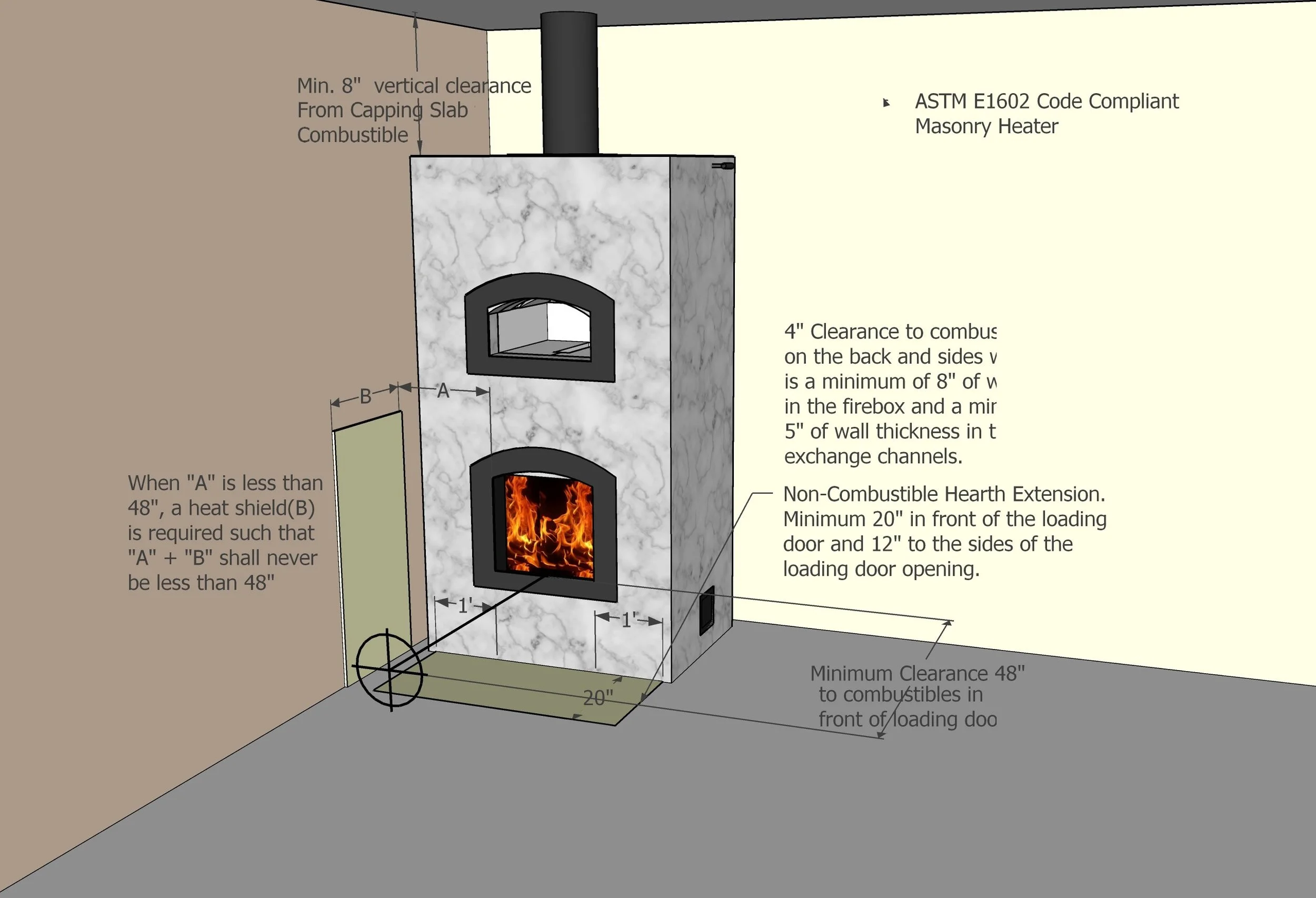
These heaters must be built on top of a masonry foundation, and they have a 36” clearance from combustibles on all sides, except in front of the loading door, which is 48” clearance to combustibles.
The exemption to the 36” clearance to combustible rule is if the masonry heater has 8” of total thickness of masonry walls (from inside to outside) in the firebox, and 5” total thickness of masonry walls (from inside to outside) in the flue gas passages.
Masonry Heaters that meet this wall thickness exemption enjoy a 4” clearance to combustibles on the sides and back, and 8” from the capping slabs to the closest overhead combustible. They still have a 48” clearance to combustibles in front of the loading door. Please see the clearance diagram below.
Example Foundations
Foundations will come in various shapes and sizes and will need to be designed to accommodate the design of the masonry heater. This common shape for a masonry heater also shows a common foundation style. Some ideas for foundations going into a finished basement include utilizing the space for a closet with one open face for the door. An ash pit is common as well and allows for minimal cleaning during the heating season. In the case where the heater will be over a hallway, a foundation can be designed where two masonry walls of a hallway are capped with the masonry heater pad, creating a foundation “tunnel”. The point of these few ideas is to show that there are many ways to “conceal” a foundation in a finished basement.
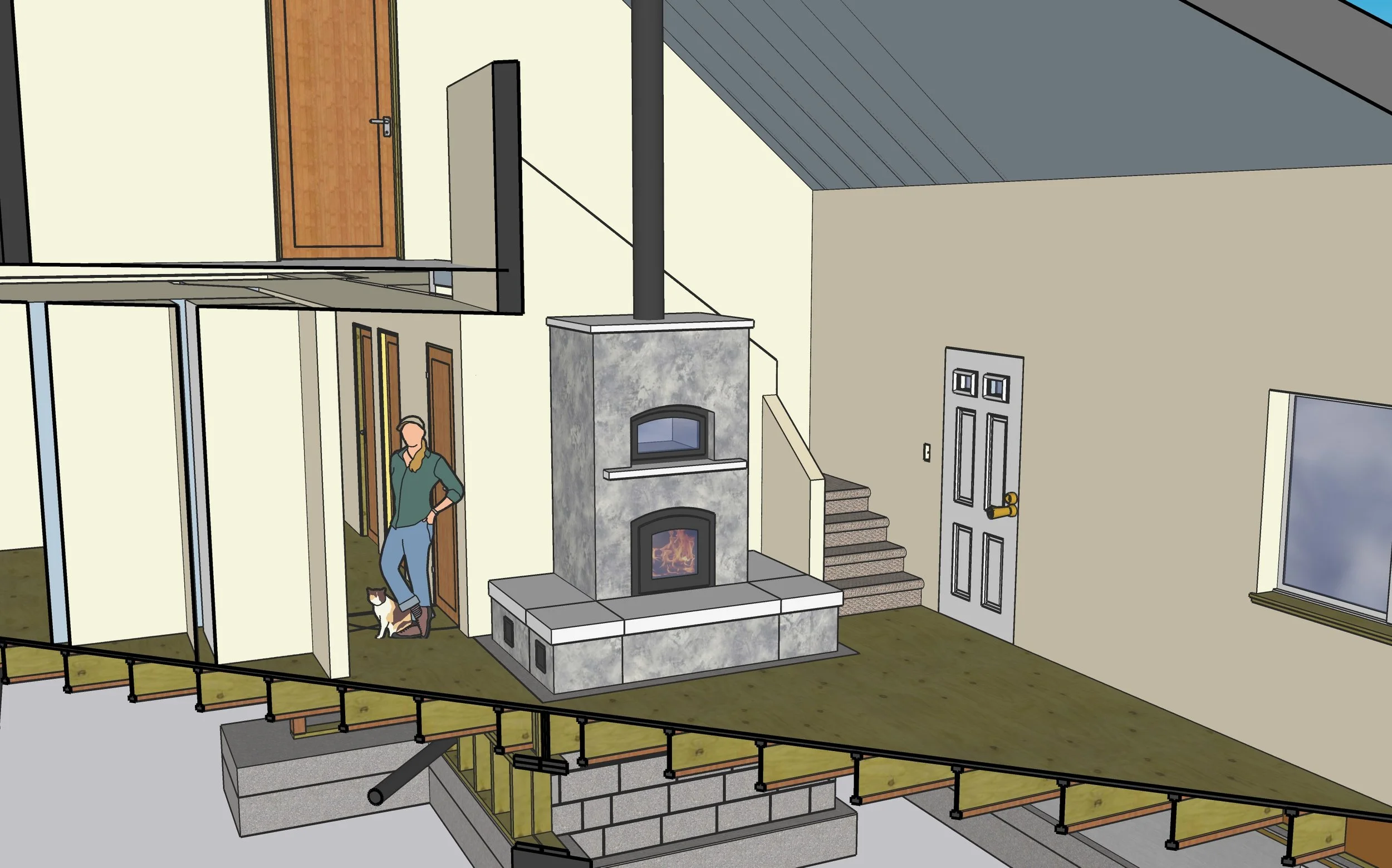
Typical Home Plan Cut Away
What is the technical definition of a masonry heater?
A masonry heater is a site-built or site-assembled, solid-fueled heating device constructed mainly of masonry materials in which the heat from intermittent fires burned rapidly in its firebox is stored in its massive structure for slow release to the building. It has an interior construction consisting of a firebox and heat exchange channels built from refractory components.
Specifically, a masonry heater has the following characteristics:
a mass of at least 800 kg. (1760 lbs.)
tight-fitting doors that are closed during the burn cycle
an overall average wall thickness not exceeding 250 mm (10 in.)
Under normal operating conditions, the external surface of the masonry heater, except immediately surrounding the fuel loading door(s), does not exceed 110 °C (230°F).
The gas path through the internal heat exchange channels downstream of the firebox includes at least one 180-degree change in flow direction, usually downward, before entering the chimney
The length of the shortest single path from the firebox exit to the chimney entrance is at least twice the largest firebox dimension
The above definitions were unanimously passed at the 1998 MHA Annual Meeting. Site-built masonry heaters in the United States are required to conform to ASTM E1602. Some manufacturers of masonry heater kits opt to certify their products according to applicable UL Standards for fireplaces rather than adhering to ASTM standards.